Tuesday, October 1, 2013

Inner Worlds, Outer Worlds, Part 3 - The Serpent & the Lotus


Inner Worlds, Outer Worlds
Part 3 - The Serpent and the Lotus
 
When the polarities of the dual world are in balance,
A third thing is born.
We find the mysterious golden key that unlocks the evolutionary forces of nature.
Because humans are almost exclusively identified exclusively with their thoughts and the outer world,
It is a rare individual which achieves the balance of the inner and outer forces which allow enlightenment;
To awaken naturally for those identified only with the illusion of enlightenment,
Enlightenment will always remain a metaphor, an idea, rather than a direct experience of one’s energy and consciousness.
The word Kundalini as used in the video below is –
 Awakened Evolutionary Consciousness
Another video explanation and paragraphs on Kundalini –
 
 
Please click on the below image to become informed about a very unique and entertaining meditation and mental training program I
 have used for years!

Thursday, September 26, 2013

INNER WORLDS, OUTER WORLDS - Part 2 - SPIRAL


Inner Worlds, Outer Worlds

Part 2 – The Spiral

(Continued from Part 1)


Today, humans try to understand the spiral with rational minds.
 
But it was never thinking that connected us to the spiral of life.
We have always been connected.

Thinking is what keeps us in the illusion of separateness.

The more we align with thought, the more removed we become from the SOURCE.

When consciousness turns within,

It becomes like the Sun’s rays,

And the Lotus within begins to grow,

We begin to see the Spiral as the link between our Inner and outer worlds.

Please click on the following to take you to this intriguing half-hour video:

 
I am watching this series along with you with expectancy of new Spiritual growth and understanding.


Please let me know your thoughts either on Facebook or the below comment section.
By the way, click on the WildDivine link below and be introduced to a guaranteed inspiring on-line world of meditation, Zen, fun game style teachings and challenges.  I have been using WildDivine myself for many years and it is my main meditation aid!

IT IS ACTIVE NOW!

Monday, September 23, 2013

INNER WORLDS, OUTER WORLDS - PART 1


Inner Worlds, Outer Worlds

Part 1 – Akasha


To see a World in a Grain of Sand

And Heaven in a Wild Flower,

Hold Infinity in the Palm of Your Hand

And Eternity in an Hour… William Blake


   The true crisis in our world is not social, political or economic.  Our crisis is a crisis of consciousness – an inability to directly experience our true nature, an inability to recognize this true nature in everyone or in all things.  To awaken one’s true self, one must awaken all beings.  There are innumerable sentient beings in the universe.


   I will be watching this series along with you and become more willing to grow in consciousness and enlightenment… let’s go along together… you and I… I am excited!  Click on the below link:


Watch for Part 2 on this site soon.


Tuesday, August 27, 2013

Einstein on Buddhism


Einstein on Buddhism

 
   I was cleaning out my wallet in preparation for an upcoming trip and discovered this quote from Einstein hidden away inside.  I would like to share it with you as food for thought:


"Buddhism has the characteristics of what would be expected in a cosmic religion for the future:  It transcends a personal God, avoids Dogmas and theology; it covers both the natural and spiritual; and it is based on a religious sense aspiring from the experience of all things, natural and spiritual, as a meaningful unity.
 
"If there  is a religion that would cope with modern scientific needs it would be Buddhism.
 

"A human being is part of the whole, called by us 'Universe'; a part limited in time and space.  He experiences himself, his thoughts and feelings as something separated from the rest - a kind of optical delusion of his consciousness.  This delusion is a kind of prison for us, restricting us to our personal desires and affection for a few persons nearest us. 
 
 "Our task must be to free ourselves from this prison by widening our circle of compassion to embrace all living creatures and the whole nature in its beauty.  Nobody is able to achieve this completely but striving for such achievement is, in itself, a part of the liberation and a foundation for inner security."
 

Quoted by:
John Potts
(Arriving Home at the Source -Dharma name)
Subtle Activist
 
Check out a unique, spiritual, fun, educational web world which teaches us how to meditate properly and groom healthy thinking and breathing.  I have been a part of it for over 10 years and use it daily for my personal meditation:


Saturday, August 17, 2013

SPIRIT FOREST

SPIRIT FOREST

By

John Potts

(Arriving Home at the Source)


Spirit Forest


      Recently, I went a little eccentric, not ever having any experience with them, and bought via mail-order, seven (yep, 7) indoor Bonsai Trees to keep in “my” room where I hangout in my man-cave.  I had sense enough to buy a book on the subject and did some research online… but seven… well, that’s me.  (Don’t quit reading – there are terrific videos from You-Tube down below you can’t miss!)

   I had an idea of putting them on water trays as close as possible on this small table 27”x18” next to my laptop and pretty close to the bed in a small bedroom.  I would utilize a growing lamp in place of the sun.  Well, all seven trees and related supplies and equipment came within 3 days of each other two or three weeks ago.

   I felt inspired to make this a unique forest with a spirit world fantasy theme.  However, let me say here that I am one of those people who say that everything in this world (and universe) is connected somehow by something I call spirit; indeed everything we can see and feel is not reality but is whatever holds the tiny molecules, atoms, etc together beyond the visual that we see… I will call it “spirit”.  You may call it something else, but it is mind-boggling and trying to understand the science of it all and integrate it with our knowing/belief system is interesting and exciting when we get into it.

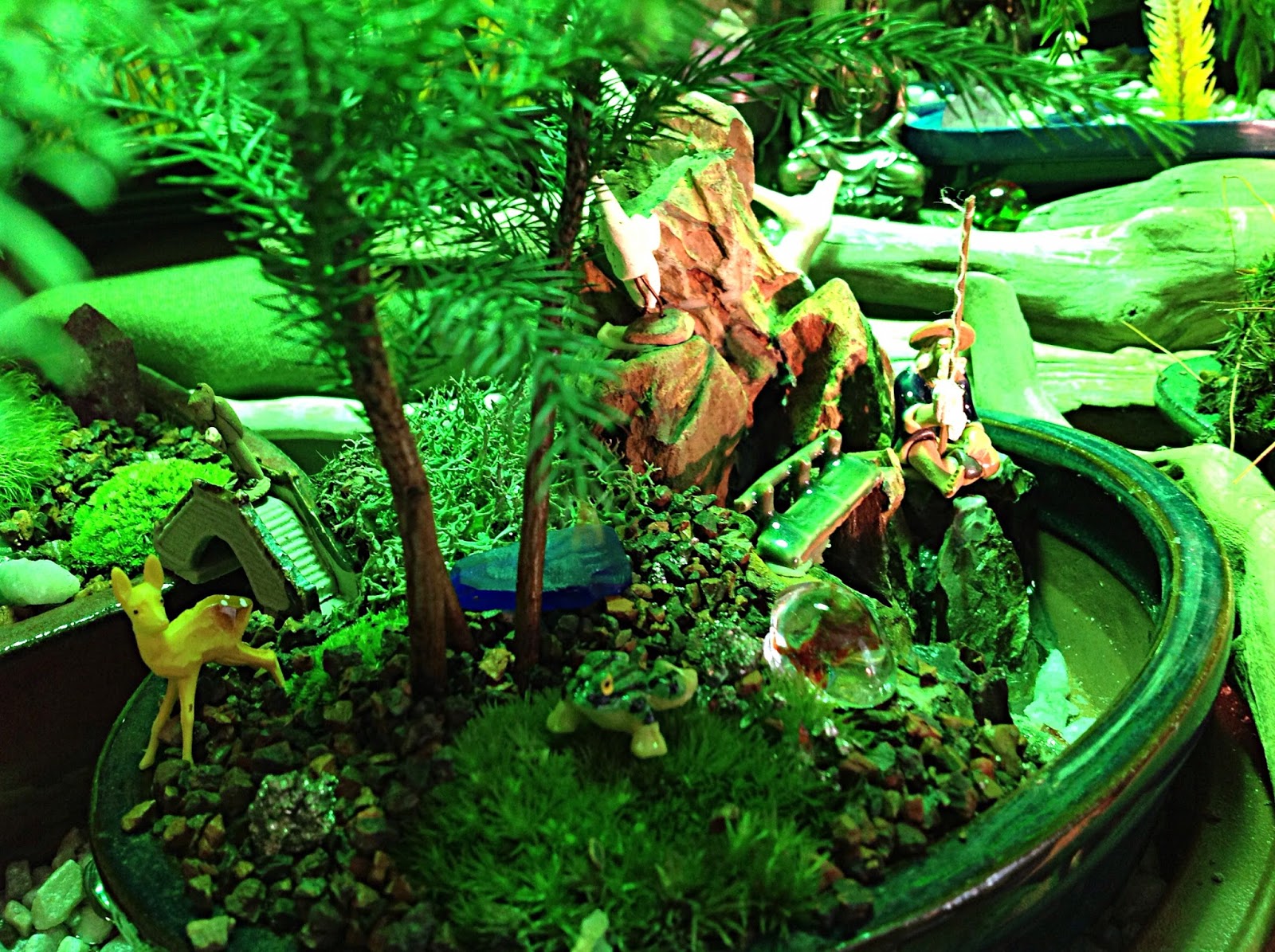
   Anyway, this “Spirit Forest” of Bonsai Trees I put together is decorated with tiny statues, ground moss, a few fishermen, colored stones, tiny gold fragments, and drift wood which I have been saving for over a decade.  I am inserting photos of this creation.
 
   When I awake in the morning, I can actually feel the presence and joy of my Spirit Forest.  I speak with the creation and lightly rub my hands over the leaves in a nurturing way.  I can actually feel the life in the trees communicating with me.  I think that they like the theme of the forest in which I placed them. 
Click on this video link for my first ever YouTube video production!
   Yes, I think plants have more than just biological life as there is online research complete with videos which I intend to show you further along in this blog.


      Plants are very much alive. Not only do they dislike human noise but they also posses the capacity to learn and communicate.


Perhaps even more astonishing is that plants can also make music.
Have you ever heard the incredible music of the plants?
Plants can actually sing and compose music and listening to it is truly beautiful and relaxing!
Ever since 1975, researchers at Damanhur, in northern Italy have been experimenting with plants, trying to learn more about their unique properties.
Researchers use devices which they have created to measure the re-activity of the plants to their environment. The devices judge the plants' capacity to learn and communicate.
Using a simple principle, the researchers used a variation of the Wheatstone bridge, an electrical circuit used to measure an unknown electrical resistance by balancing two legs of a bridge circuit, one leg of which includes the unknown component.
This device has 3 fixed resistances and 1 variable one. Electrical differences between the leaves and the roots of the plant are measured. These differences can then be translated into a variety of effects, including music, turning on lights, movement and many others.
There is no danger to the plants as the researchers use very low intensity electrical currents.
Researchers state that every living creature whether animal or plant, produces variations of electrical potential, depending on the emotions being experienced at the time.  Click on this video link:
The music starts at around 2:11. Credit: www.damanhur.org
The plant sends impulses to the midi-instruments. The midi-signal goes to a midi-thru-box and from there to the software. Click on this link:
The device that takes the measurements is a tool from damanhur called U1.


The plants have the most sensitive variations when they signal the arrival of the person who cares for them, when being watered, when spoken to, during the creation of music, etc.

Sensations felt within the plant induce a physiological reaction, which then expresses itself in electrical, conductive and resistance variations.

These variations can be translated in different ways, including into musical scales.

The experiments have shown that plants definitely appear to enjoy learning to use musical scales and also making their own music with the use of a synthesizer.

Although there is currently little scientific research conducted on this subject, one cannot deny that listen to these beautiful plants is a joy for the soul.
   A growing body of research shows that birds and other animals change their behavior in response to human noise, such as the din of traffic or the hum of machinery.
But human clamor doesn't just affect animals.
Because many animals also pollinate plants or eat or disperse their seeds, human noise can have ripple effects on plants, too, finds a new study reported in the March 21, 2012, issue of the journal Proceedings of the Royal Society B.
In cases where noise has ripple effects on long-lived plants like trees, the consequences could last for decades, even after the source of the noise goes away, says lead author Clinton Francis of the National Science Foundation (NSF) National Evolutionary Synthesis Center in Durham, North Carolina.
In previous studies, Francis and colleagues found that some animals increase in numbers near noisy sites, while others decline.
But could animals' different responses to human noise have indirect effects on plants, too?


  To find out, the researchers conducted a series of experiments from 2007 to 2010 in the Bureau of Land Management's Rattlesnake Canyon Wildlife Area in northwestern New Mexico.


The region is home to thousands of natural gas wells, many of which are coupled with noisy compressors for extracting the gas and transporting it through pipelines.

The compressors roar and rumble day and night, every day of the year.

The advantage of working in natural gas sites is they allow scientists to study noise and its effects on wildlife without the confounding factors in noisy areas like roadways or cities, such as pollution from artificial light and chemicals, or collisions with cars.

As part of their research, Francis and colleagues first conducted an experiment using patches of artificial plants designed to mimic a common red wildflower in the area called scarlet gilia.


Each patch consisted of five artificial plants with three "flowers" each--microcentrifuge tubes wrapped in red electrical tape--which were filled with a fixed amount of sugar water for nectar. 
To help in estimating pollen transfer within and between the patches, the researchers also dusted the flowers of one plant per patch with artificial pollen, using a different color for each patch.
Din levels at noisy patches were similar to that of a highway heard from 500 meters away, Francis said.
When the researchers compared the number of pollinator visits at noisy and quiet sites, they found that one bird species in particular--the black-chinned hummingbird--made five times more visits to noisy sites than quiet ones.
 
 
"Black-chinned hummingbirds may prefer noisy sites because another bird species that preys on their nestlings, the western scrub jay, tends to avoid those areas," Francis said.
Pollen transfer was also more common in the noisy sites.
If more hummingbird visits and greater pollen transfer translate to higher seed production for the plants, the results suggest that "hummingbird-pollinated plants such as scarlet gilia may indirectly benefit from noise," Francis said.
Another set of experiments revealed that noise may indirectly benefit some plants, but is bad news for others. 
 
 
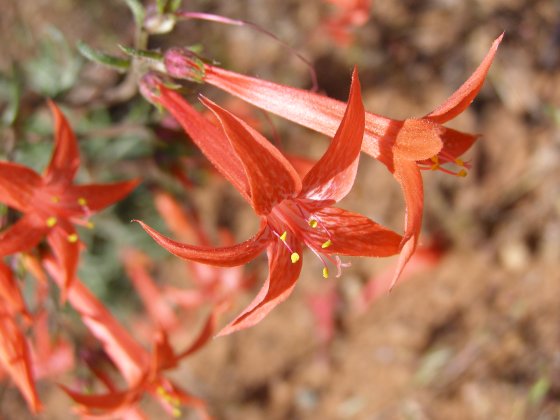
Scarlet gilia, which attracts hummingbirds, was a subject in one "noise experiment."
Credit: National Park Service
In a second series of experiments at the same study site, the researchers set out to discover what noise might mean for tree seeds and seedlings, using one of the dominant trees in the area--the pinion pine.
Pinion pine seeds that aren't plucked from their cones fall to the ground and are eaten by birds and other animals.
To find out if noise affected the number of pinion pine seeds that animals ate, the researchers scattered pinion pine seeds beneath 120 pinion pine trees in noisy and quiet sites, using a motion-triggered camera to figure out what animals took the seeds.
After three days, several animals were spotted feeding on the seeds, including mice, chipmunks, squirrels, birds and rabbits.
But two animals in particular differed between quiet and noisy sites--mice, which preferred noisy sites, and western scrub jays, which avoided them altogether.
 
 
Human noise affects plants such as pinion pine, whose seed-dispersers avoid the clamor.
Credit: Clinton Francis
Piñon pine seeds that are eaten by mice don't survive the passage through the animal's gut, Francis said, so the boost in mouse populations near noisy sites could be bad news for pine seedlings in those areas.
In contrast, a single western scrub jay may take hundreds to thousands of seeds, only to hide them in the soil to eat later in the year.
The seeds they fail to relocate will eventually germinate, so the preference of western scrub jays for quiet areas means that pinion pines in those areas are likely to benefit. 
 
In keeping with their seed results, the researchers counted the number of pinion pine seedlings and found that they were four times as abundant in quiet sites compared with noisy ones.
It may take decades for a pinion pine to grow from a seedling into a full-grown tree, Francis said, so the consequences of noise may last longer than scientists thought.
"Fewer seedlings in noisy areas might eventually mean fewer mature trees, but because pinion pines are so slow-growing the shift could have gone undetected for years," he said.
"Fewer pinion pine trees would mean less critical habitat for the hundreds of species that depend on them for survival."
   So, there you have it.  Oh, did you hear the lady in one of the videos say that she “meditates” together with the plants?!  What an interesting subject which clearly draws me closer to unity with everything in this fascinating universe of ours and… it helps feed my concept that there is something eternal within my body which will continue to live forever after this body lies lifeless in decay.
   The real me, my spirit, or whatever you wish to call it, will continue to exist, perhaps even in… a life between lives… then reincarnated… Well, why not; the more science and humans who are in touch with their spirit tell us about this earth and universe, the more plausible it seems! Check Amazon.com for books by regression therapists on life between lives and reincarnation... there are many.
(Most of the plant research printed above came from http://www.messagetoeagle.com/singingplants.php )
           Feel free to let me know what you think
                I would LOVE to hear from you!
                                   John Potts
                     (Arriving Home at the Source)


Monday, July 22, 2013

Where Did We Come From?


Where Did We Come From?
 
Found posted on http://www.wbsysl.org/962/

Cause& Effect

Where did we come from? We come from out of the past, even as today comes out of yesterday. This life is the result of the past life, before this life. We come from out of the things we have done before, out of the past labours unfinished. Although we have labored, our work is not complete, if it were we should not be here, we should be somewhere higher. We come out of past vices and virtues, vices and virtues we have accumulated, out of the darkness of our own desires.
Why are we here? We are here because the past gives birth to the future. We are brought here by our own joys, our own sorrows, but most of all we are led here by our desires.
Where are we going? We are going to the results of our actions, the effects of our causes. Those whose labours are unfinished will go around the wheel of life, samsara, returning again and again until their labours are finished and the state of Nibbana, the complete cessation of suffering, has been reached.
Unless one knows Paticcasamuppada one cannot begin to understand the real nature and function of cause and effect, the cause of suffering, how suffering arises. In meditation there is a stage where one becomes free from doubt about one’s own existence; this requires a knowledge of Paticcasamuppada, a proper understanding of cause and effect, so that no doubt exists as to how one arises and passes away as a human being.
The lives of men, in fact the whole universe of living beings, are governed by unchanging, eternal laws, such as the laws of cause and effect, the laws of the mind and of the laws of nature. The whole universe is governed by these eternal laws, and not by any imaginary God, a God susceptible to change if one believes that God has compassion to be aroused and partiality won. To the Buddhist the laws of nature, the laws of righteousness which govern the universe, are the always the same, the same for one and all. Therefore, a man’s duty is not to break these rules, not to try to change these laws by means of any prayer or guarding against them, but to know and understand them and to live in harmony with them.
The past is the background against which life goes on from moment to moment, the future is yet to be. One the present moment exists, and the responsibility of using the present moment for good or ill lies with each individual.
The present being, present existence, is conditioned by how one faced circumstances in the last, and in all past existences. Our present position in character and circumstances is the result of all that one has been up to the present, but what will be in the future depends on what one does now in the present.
 
I could not resist posting this article when I found it today; it seems to me to be the best explanation of Reincarnation I have found.  I am excited about this find!
 
John Potts, Arriving Home at the Source

Saturday, July 20, 2013

Activism - Two Types


ACTIVISM – TwoTypes

By John Potts
Arriving Home at the Source (Dharma Name) 

   Quite a bit of changes have been instituted around the world due to citizens becoming involved in Activism to bring their desires for change home to the target government or institution.  There are two general types of activism which I would like to explain in this essay.  This information was recently put together to lead a mindfulness meditation group into an informative meditation toward changing violence and suffering around the world, including the earth itself, into peace and health.  Thus, you will see sample meditation instructions herein.

   First, there are at least two general types of activism:

I.Traditional methods of FRONT-LINE activism:

1.      Marches

2.      Demonstrations

3.      Putting one’s body in front of bulldozers

4.      Living high in a tree to protect the cutting of a forest, etc, etc…

These represent only the most immediate and direct expressions of action for social change. 

II.Subtle Activism:

1.     an activity of consciousness or spirit, such as:

2.     prayer,

3.     meditation,

4.     ecstatic dance or other types of rituals,

5.     intended to support collective healing and social change,

6.     grows from the idea that there are many effective ways – some newly emerging, many as old as humanity – to positively influence social change other than overt political action.

   It is possible to identify a spectrum of social action that proceeds from the more obvious or overt forms down a graded scale of increasing subtlety. At the subtlest level, even certain activities of consciousness or spirit can be recognized as forms of social action.

   A global meditation and prayer event, in which hundreds of thousands of people around the planet unite in silence and prayers for world peace, is a prime example of subtle activism.

   On March 15, 2002, over 600,000 Sri Lankans traveled from all corners of the country to the sacred city of Anuradhapura to participate in the world’s largest ever peace meditation. After a few brief spoken prayers by members of the clergy of various Sri Lankan religions, the event organizer Dr. Ariyaratne guided the massive crowd into a simple mindful breathing meditation.  Over half a million people settled into deep stillness and silence for an entire hour. The meditation was clearly a political statement, yet there were no placards or speeches – simply - silence.

Dr. Ariyaratne, who since 1958 had worked on refugee and rehabilitation projects with both sides of Sri Lanka’s bitter civil war, introduced the peace meditations in the late 1990’s in order to “change the psycho-sphere.” The American peace activist Joanna Macy, present at the March 15 meditation, called it

 “the biggest silence I ever heard…. I thought: This is the sound of bombs and landmines not exploding, of rockets not launched, of machine guns laid aside. This is possible.”

   During the Battle of Britain, Londoners of various faiths united daily for a minute of silence after the chiming of Big Ben at 9pm – a practice intended to strengthen the moral resolve of the city’s inhabitants during the ordeal of war.

   In recent years, the expansion of the global interfaith movement and the emergence of the Internet have given rise to numerous globally synchronized meditation and prayer vigils that link individuals and communities around the world for shared silence and prayers for peace. For example, in early 2003 during the buildup to the Iraq war, the Global Interfaith Prayer Vigil brought together over 100,000 monks, nuns and other committed practitioners of a wide variety of faiths for a fifteen-week vigil to pray for a peaceful solution.

Sample 20-minute Group Meditation

  Leader: You may, as always, use your own method of meditation, but if you would like to listen to my words to guide you periodically, during your breathing cycle – breathing in/breathing out – I will name aloud a location or social situation which is in need of collective healing or social change… you might want to try to visualize the situation I name and imagine the situation improving, or think projecting the words “Peace and Healing” toward  the place or situation, or otherwise emanate feelings of peace and compassion toward the location which I name.  The choice is yours. Feel free to add your own silently. Just don’t keep visualizing the tragic situation remaining un-improved.

 After a while, I will name several charities that work with our donations in needy areas around the world… perhaps you will want to send thoughts of generous donations to the charity and wisdom to use the funds where needed… and add the charities which you help support.

    After 20 minutes, we will come out of the meditation & I will add a few more thoughts to consider and then go around the room and introduce ourselves and comment on what this topic means to you as you desire. 

MEDITATION TOPICS

(Spoken at periodic intervals by the leader)

Apartheid & ethnic cleansing in Burma

Egyptian political and religious unrest

Afghanistan

Al Qaeda and Taliban becoming peaceful

U.S. poverty and crime areas

Unity amongst Congressional members in the U.S. congress

Pres Obama’s wisdom

Hostility between Japan, China and N. Korea

China’s hostility toward Tibet and the families of those Buddhists who were celebrating the Dalai Lama’s birthday recently killed by Chinese soldiers in Tibet

Actions needed to be taken to reverse climate change

Sahel, Nigeria, W. Africa drought, hunger, malnourished

Military personnel in harms way 

Charities

Save the Children

Mercy Corps

Doctors w/o Borders

Amnesty Intl

Savetibet.org

If appropriate: Various local church outreach programs such as The Lighthouse, UN Global Justice Committee, UU Social Justice Light a Candle projects, Neighborhood Leadership Academy, overseas church partnership projects, etc.
 
(Bring the group out of meditation in accordance with local practice.) 

Further Thoughts on Activism

  Subtle activism is primarily intended for collective healing and social transformation. Meditating for one’s own liberation would not be considered subtle activism, but meditating for peace on Earth would be. Praying for the health of one’s personal friend is not subtle activism, but praying for a community struck by natural disaster is. It is important and wonderful to send healing to ourselves, our friends, and our families, but the goal of subtle activism is to encourage us to extend our healing focus beyond our local family to our greater community.

Forms of Subtle Activism

   Many kinds of actions can exert subtle positive influence on the social realm and thus might be considered forms of subtle activism. For example, certain kinds of intellectual contributions, and various forms of inspirational art and music are types of action that support positive social change through less overt or direct means than conventional approaches to activism (demonstrations, marches, lobbying, etc).

   Two kinds of Subtle Activism which I am involved in are

1.      Re-posting collective and social needs on Facebook, needs which are made public by charities, trying to get my FB friends to look out of their own situation into the needs of America and the world. 

2.     By signing petitions and encouraging my FB friends to sign the petitions for collective and social justice.

3.        I also help support Amnesty International with funds and also preparing and mailing letters to leaders of countries on behalf of activists and other victims who have been taken prisoner for their positive work and are being otherwise abused. 
 
4.   Meditation focused on collective needs.  

We are especially interested in the spiritual dimension of subtle activism, hence our definition:  

“those forms of spiritual practice intended to support collective healing and social change.”

“Spiritual practice” means prayer, meditation, ritual, or any other kind of spiritual or consciousness practice, from any tradition. It includes ecstatic dance, devotional chanting, and other kinds of expressive practices. We understand that the word “spiritual” means different things for different people. I consider a practice to be “spiritual” if it is oriented toward wholeness and healing and motivated by universal values such as love, compassion, and universal justice. It is not necessary that the approach be explicitly spiritual. For example, we would consider a practice that inspires awe and reverence for the Earth to be spiritual, even if the word spiritual is not mentioned.

Subtle activism also includes certain kinds of relational practices intended to help heal aspects of our collective shadow, especially when these take place in a sacred context.  

Individual Inner Subtle Activism 

In individual inner work, most approaches include some form of the following two dimensions:

   1) Making contact with our deeper essence through meditation, prayer or other spiritual practice; and

   2) Transforming our limiting beliefs and behavior patterns by working through critical issues from our personal history.

    Similarly, an important dimension of spiritual practices oriented toward collective healing and social transformation is a process of:

Bringing up to consciousness ancient wounds and limiting patterns of thought inherited from our collective history (e.g., racism, sexism).

   Leading examples of this kind of subtle activism include

1.     Women and men come together in sacred space to heal gender injustice

2.     People uncover their innate connections with each other and the web of life, and

3.     Working with groups that acknowledge and engage the political and psychological dimensions of issues that arise between members of the group.

I believe that there is enormous untapped power in these kinds of practices to support collective healing and social change.

   I consider myself to be a Social Activist.  I invite you to join me in these endeavors.  Showing talent, initiative, concern, devotion, becoming a pest… (as I am on Facebook) or just plain work are encouraged. 

I suggest that you make the following your own meditation/prayer focus to help compassion to radiate forth:

A Quote From The Digha Nikay

“I put away all hindrances,

I let my mind full of love pervade one quarter of the world,

and so too the second quarter,

and so the third, and so the fourth.

And thus the whole wide world,

above,

below,

around and everywhere,

I altogether continue to pervade with love filled thought,

abounding,

sublime,

beyond measure,

free from hatred and ill will.”

I Pray with love and compassion for all to live in peace and health.

I Give generously to heal the plight of the needy.

I Go into our world to bring love and compassion…We are all one! 
 
 
Some of these ideas have been compiled from the following web site:

Many thanks to gaiafield.net!
(The above presentation was given by John Potts at the Mindfulness Meditation Group of Annapolis - Unitarian Universalist Church)
Go In Peace and Compassion
John Potts
Arriving Home at the Source
 (Dharma Name)